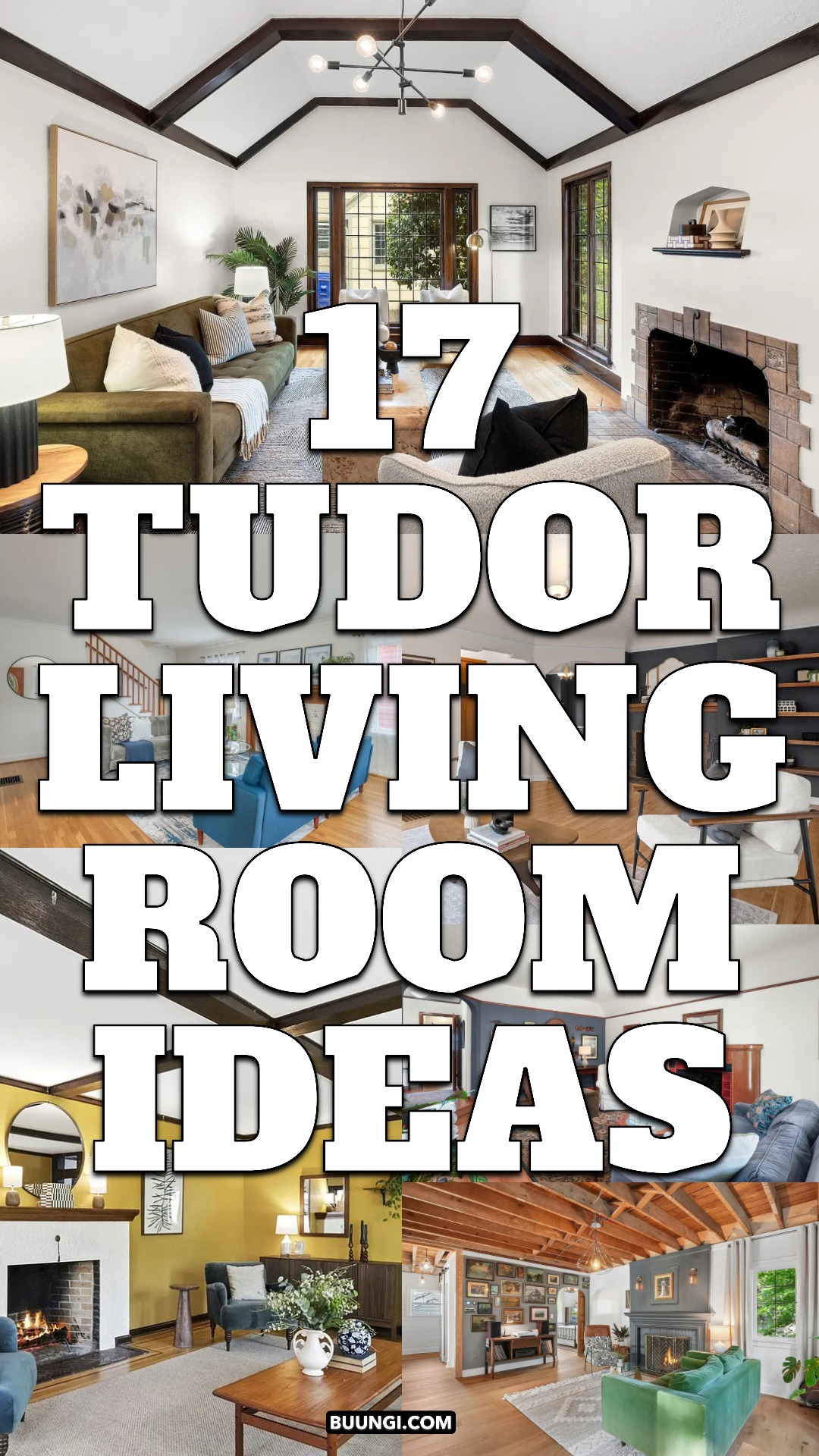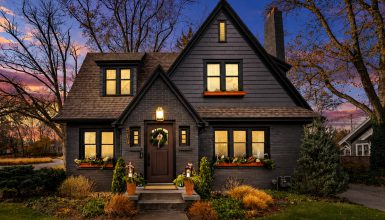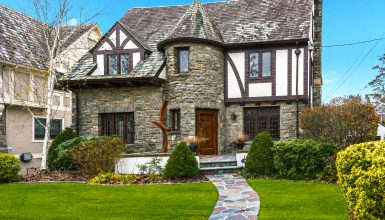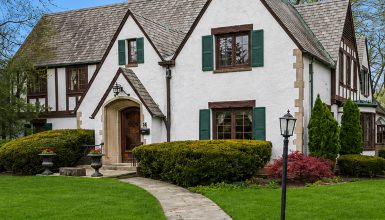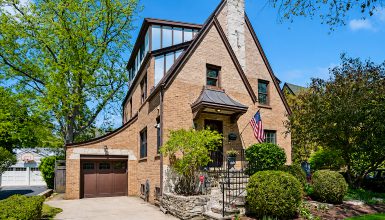
Tudor living rooms have a way of feeling warm, rich, and full of character. Wood trim, arched openings, large fireplaces, deep colors, and classic windows give these spaces their charm. Still, Tudor style does not have to feel dark or old-fashioned. These living rooms show how light walls, simple furniture, soft fabrics, and fresh color can make Tudor details feel right at home today.
1. Warm Wood Tudor Living Room With a Classic Fireplace
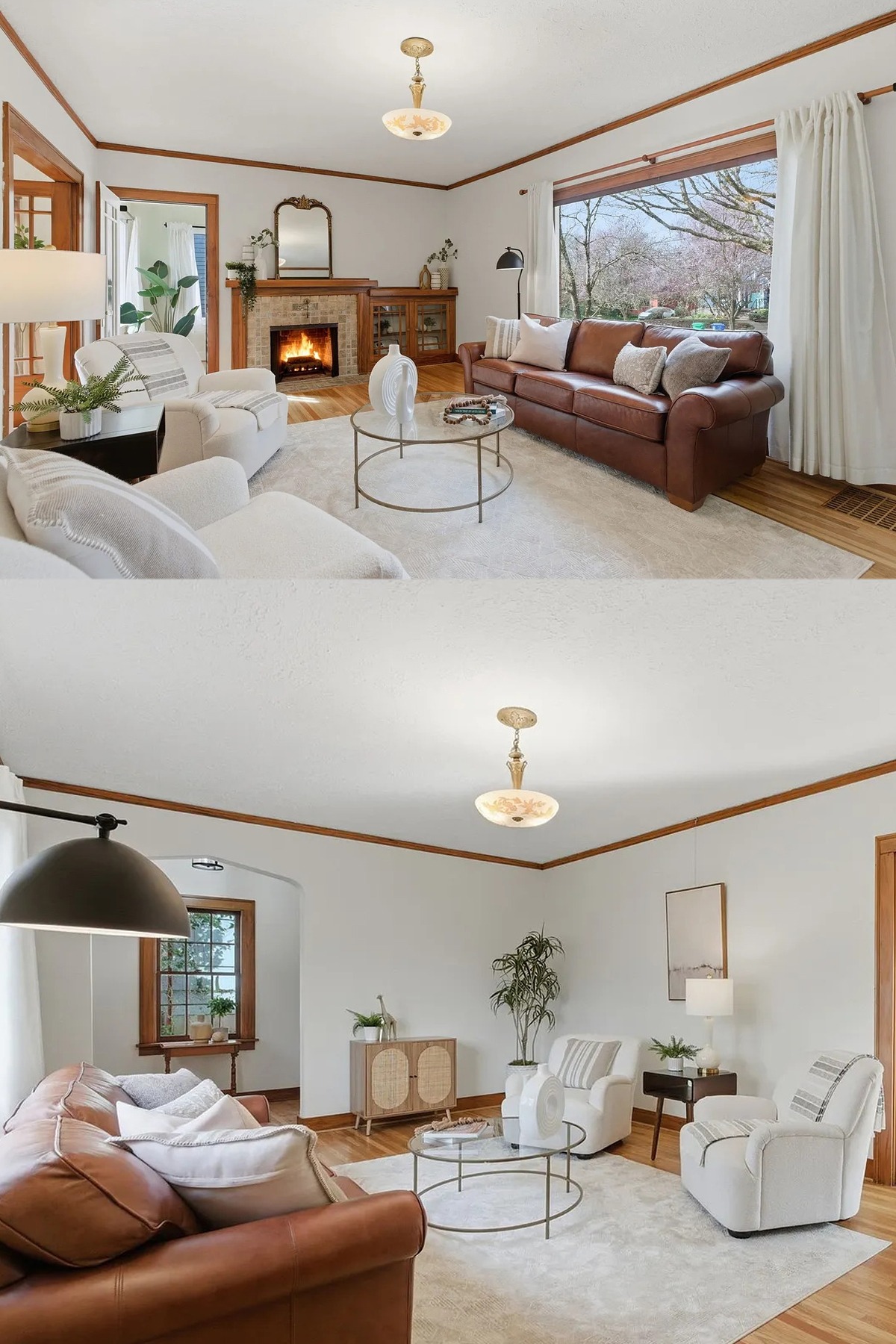
This room takes a light and relaxed approach to Tudor style. The first thing you notice is the warm wood trim. It outlines the ceiling, windows, and doorways. That simple detail gives the pale walls more depth.
The fireplace adds another strong Tudor cue. It has a wood mantel, tile surround, and built-in cabinet beside it. Together, these features make the fireplace wall feel like part of the home’s original design.
At the same time, the furniture keeps the room from feeling too formal. A brown leather sofa adds warmth. Soft white chairs lighten the look. The pale rug ties everything together.
The large picture window also matters. Tudor interiors can feel dark when they have a lot of wood. Here, the wide window brings in enough light to balance the deeper tones.
The result feels comfortable rather than themed. You get Tudor warmth without filling the space with heavy antique furniture.
Design cues:
- Natural wood crown trim
- Wood window and door casings
- Tile fireplace surround
- Traditional wood mantel
- Built-in glass-front cabinet
- Hardwood floors
- Warm brown leather sofa
- Soft cream upholstery
- Large picture window
- Simple neutral walls
2. Fresh Tudor Living Room With a Black Brick Fireplace
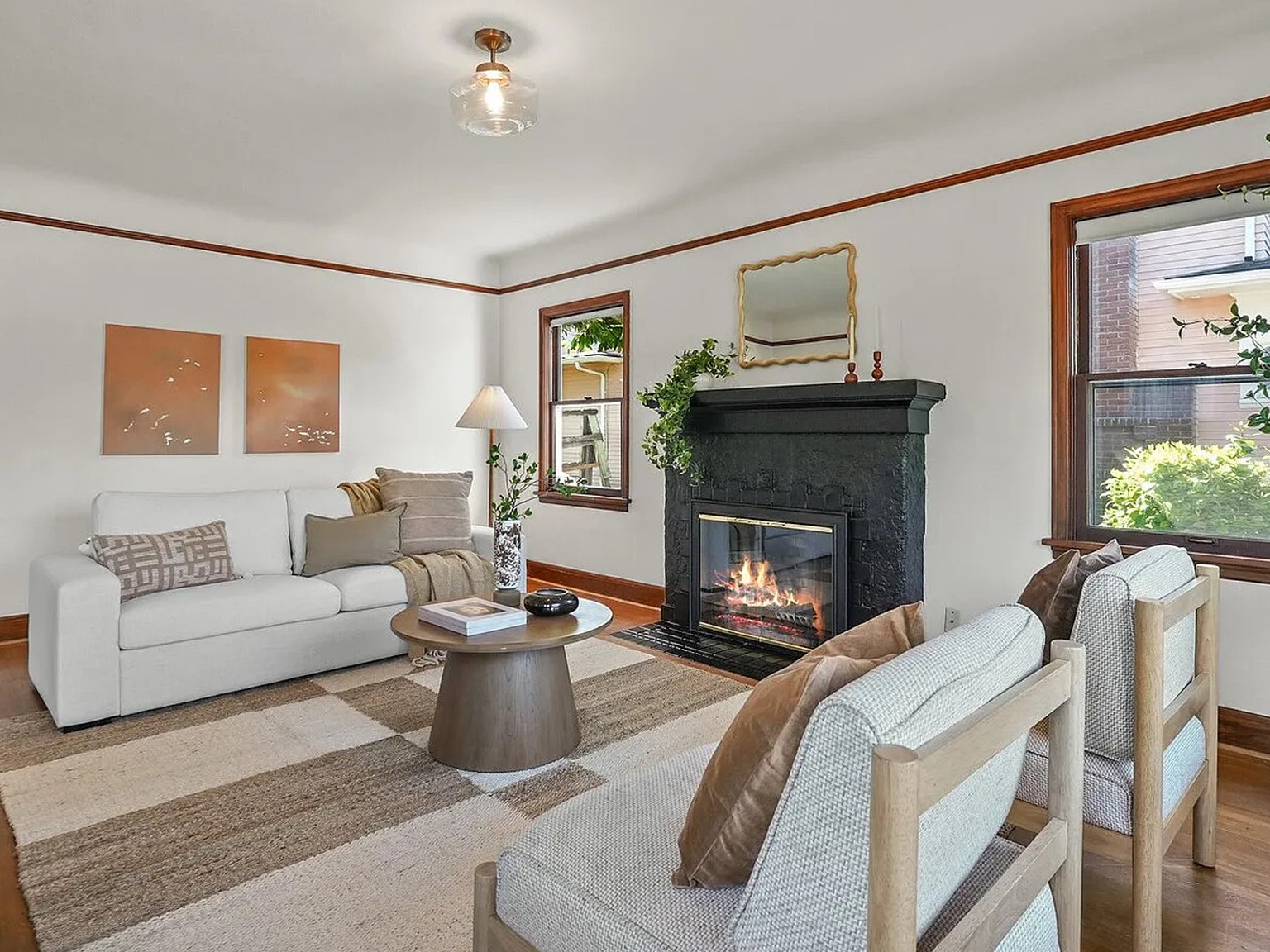
This room shows how one bold change can give an older Tudor living room a fresh look.
The black-painted fireplace creates the main focal point. Its dark tone feels strong and historic. Yet the clean finish gives it a modern edge. It also works well with the original dark wood trim around the windows.
The large arched window is one of the best Tudor features in the room. Its dark muntins create a grid of small panes. That gives the window the handcrafted look often linked with early Tudor Revival homes.
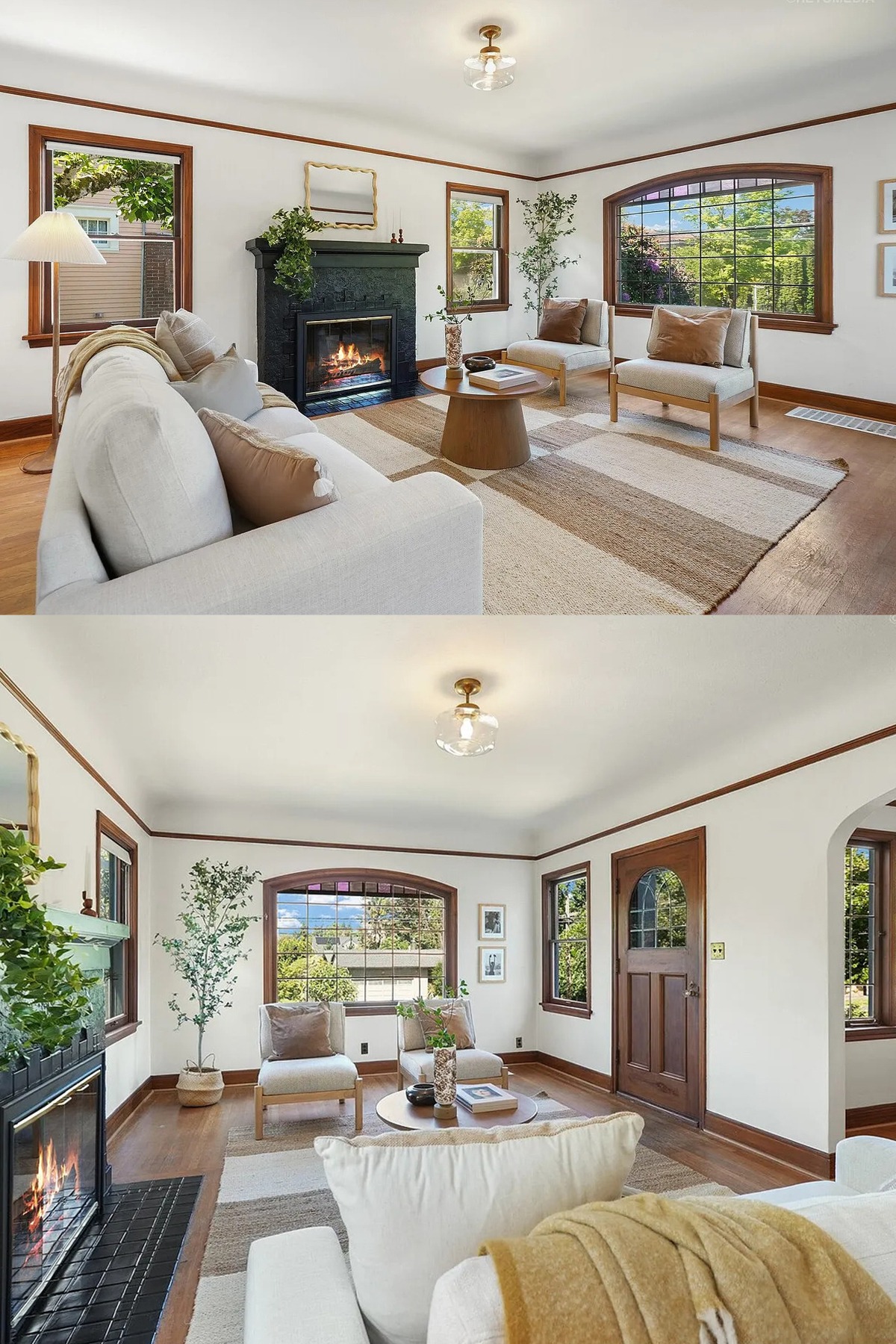
The furniture stays simple. A long cream sofa sits across from two light wood chairs. The pieces have low profiles and clean lines. Because of that, they do not fight with the older architecture.
A soft geometric rug adds pattern without making the room busy. Meanwhile, plants bring in natural color.
This is a smart way to update Tudor interiors. Keep the strong architectural details. Then use quieter furniture around them.
Design cues:
- Arched multi-pane window
- Dark stained wood trim
- Black-painted brick fireplace
- Thick fireplace mantel
- Hardwood flooring
- Cream sofa
- Light wood accent chairs
- Neutral geometric rug
- Organic greenery
- Simple round wood table
3. Grand Tudor Living Room With an Ornate Wood Fireplace
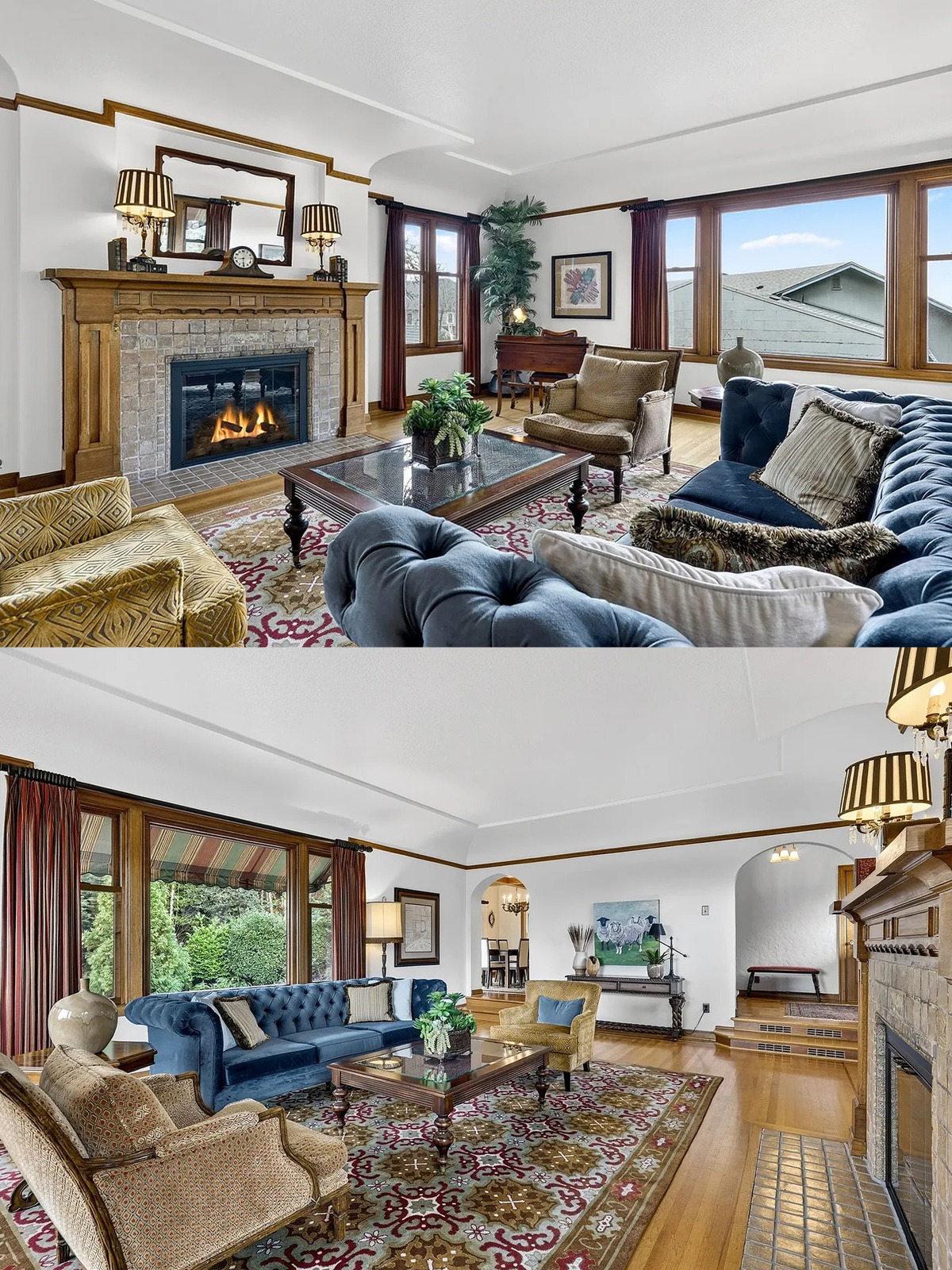
This room leans into the richer side of Tudor design.
The fireplace is the star. Its large oak mantel has deep trim, carved details, and thick vertical supports. The pale tile around the firebox creates contrast while still feeling old and handcrafted.
Then there is the ceiling. The stepped ceiling edges and dark trim add shape above the room. These details help create the layered look that older Tudor homes often have.
The furniture supports the historic mood. Deep blue tufted seating feels plush and formal. An antique-style armchair adds another layer of age. A detailed rug brings in burgundy, cream, and muted gold.
Even the lamps on the mantel add to the story. Their striped shades feel decorative and collected rather than sleek.
This room works because it accepts the home’s history. Instead of hiding the ornate fireplace, it builds the whole design around it.
Design cues:
- Large carved wood mantel
- Vintage tile fireplace
- Deep blue tufted furniture
- Decorative ceiling trim
- Dark wood window casings
- Traditional patterned rug
- Antique-style accent chair
- Framed mirror above the mantel
- Warm wood coffee table
- Decorative table lamps
4. Light Tudor Living Room With a Simple Hearth
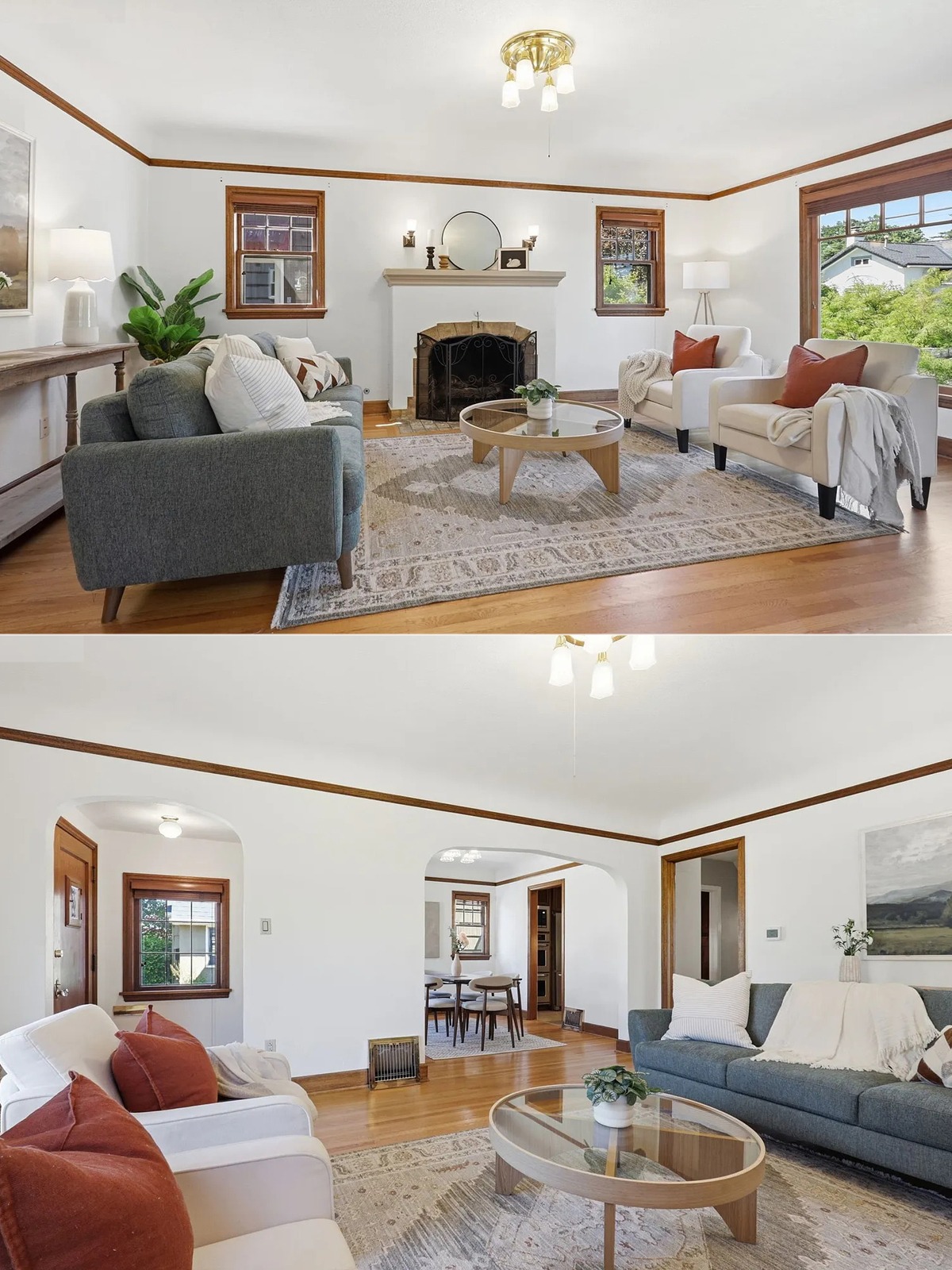
This room proves that Tudor interiors do not have to feel dark.
The white walls create a clean backdrop. However, the original wood window trim remains in place. That balance is important. The light walls brighten the room, while the wood keeps its Tudor character.
The fireplace has a simple painted mantel. Its small brick arch gives it an older feel. Rather than using a large, ornate surround, this design lets the fireplace feel quiet and natural.
The furniture is soft and casual. A muted blue-gray sofa gives the space color. Two white armchairs keep the seating area bright. Rust-colored pillows add warmth.
A large pale rug covers much of the hardwood floor. It makes the room feel softer while still leaving a border of original wood visible.
This is a good example of gentle Tudor decorating. You do not need carved wood everywhere. A few historic details can carry the whole room.
Design cues:
- Original wood window casings
- Small brick fireplace
- Simple mantel shelf
- White walls
- Hardwood floors
- Blue-gray sofa
- White armchairs
- Rust accent pillows
- Soft vintage-look rug
- Round wood and glass coffee table
5. Tudor Living Room With Exposed Wood Rafters
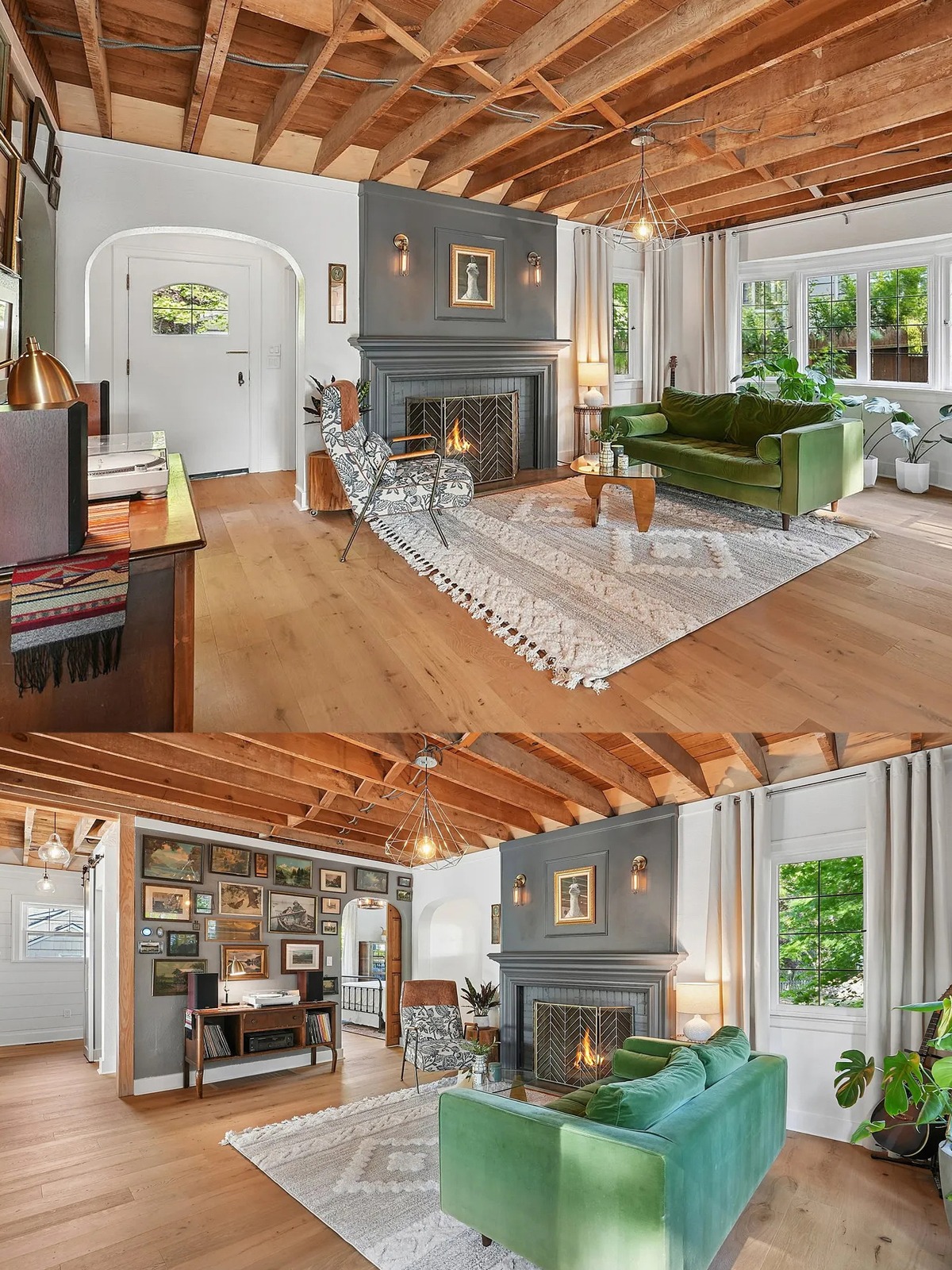
Few features create Tudor drama as quickly as exposed wood overhead.
This room places the ceiling at center stage. Large wood rafters run across the space. The open structure gives the room a rustic and handcrafted feel. It also brings warmth high above the furniture.
The charcoal fireplace wall adds contrast. Its strong color helps the fireplace hold its own beneath the dramatic ceiling.
Then the green velvet sofa adds another deep natural shade. Green works especially well in Tudor interiors because it pairs easily with wood, stone, gray, and cream.
White walls and long curtains keep the room from becoming too dark. They also make the exposed wood stand out even more.
The furnishings feel more mid-century than traditional. Still, that mix works. Tudor homes often look their best when old architecture meets furniture from another era.
Design cues:
- Exposed wood rafters
- Natural wood ceiling structure
- Charcoal fireplace surround
- Green velvet sofa
- Arched doorway
- Large multi-pane windows
- Long neutral curtains
- Warm wood floors
- Sculptural metal light fixture
- Vintage-inspired accent chair
6. Bright Tudor Living Room With Blue Accent Chairs
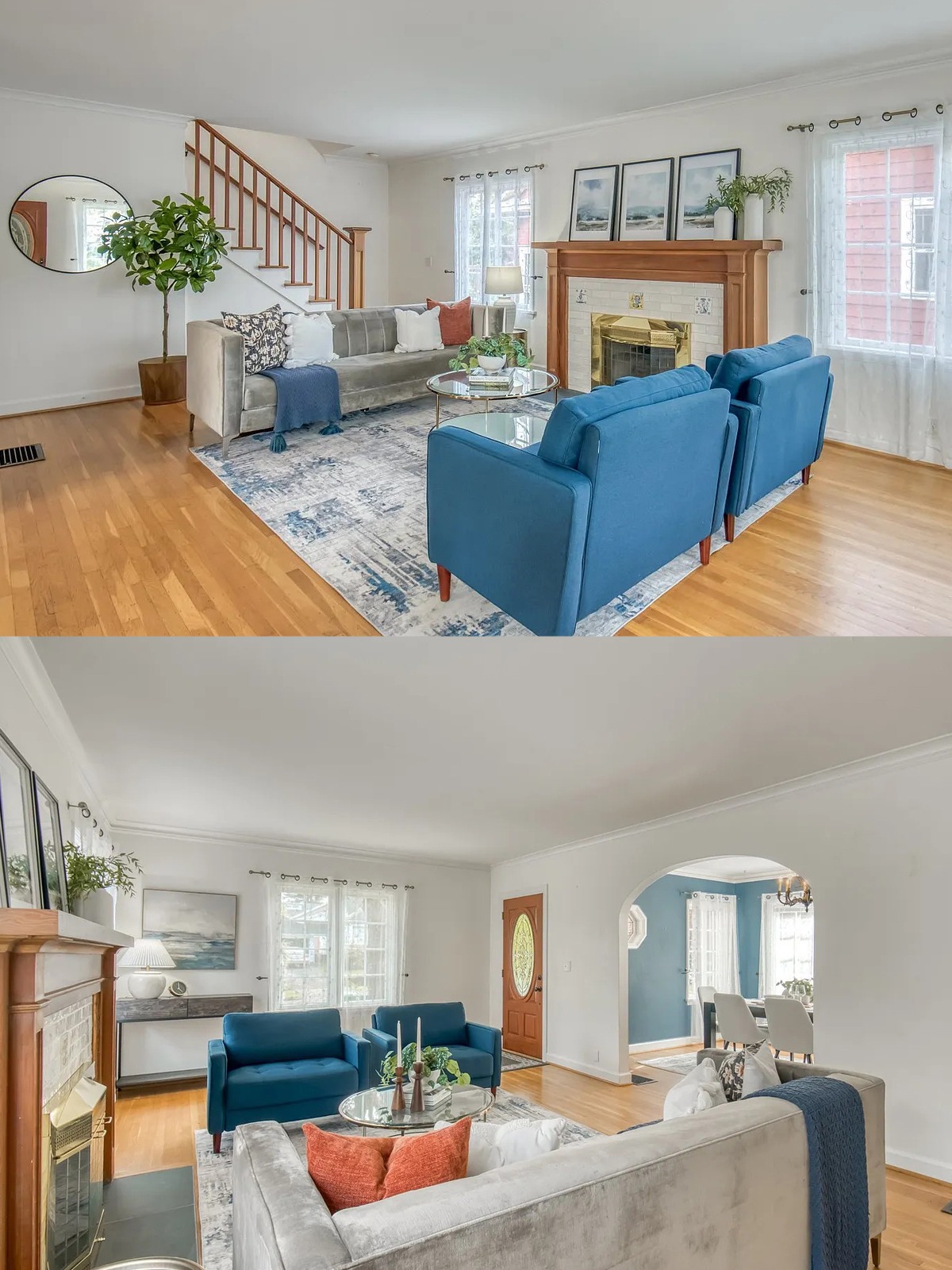
This living room feels open, cheerful, and easy to live in.
The fireplace still acts as the anchor. Its wood mantel gives the white wall a warm focal point. Small decorative tiles around the firebox add a subtle vintage touch.
Nearby, the staircase repeats the same warm wood tone. This creates a link between the living room and the rest of the house.
Two blue chairs bring in a stronger color. Their simple shapes feel modern, so the room does not become too traditional.
Sheer curtains soften the windows. They also let plenty of light pass through. That is useful in older houses, where deeper trim and small rooms can sometimes reduce natural light.
The pale rug and gray sofa create a quiet base. As a result, the blue chairs feel lively without taking over.
Design cues:
- Wood fireplace mantel
- Vintage decorative fireplace tile
- Original hardwood floors
- Wood staircase rail
- Blue upholstered chairs
- Gray sofa
- Sheer window curtains
- Round glass coffee table
- Pale patterned rug
- Simple white walls
7. Moody Tudor Living Room With Red Fireplace Tile
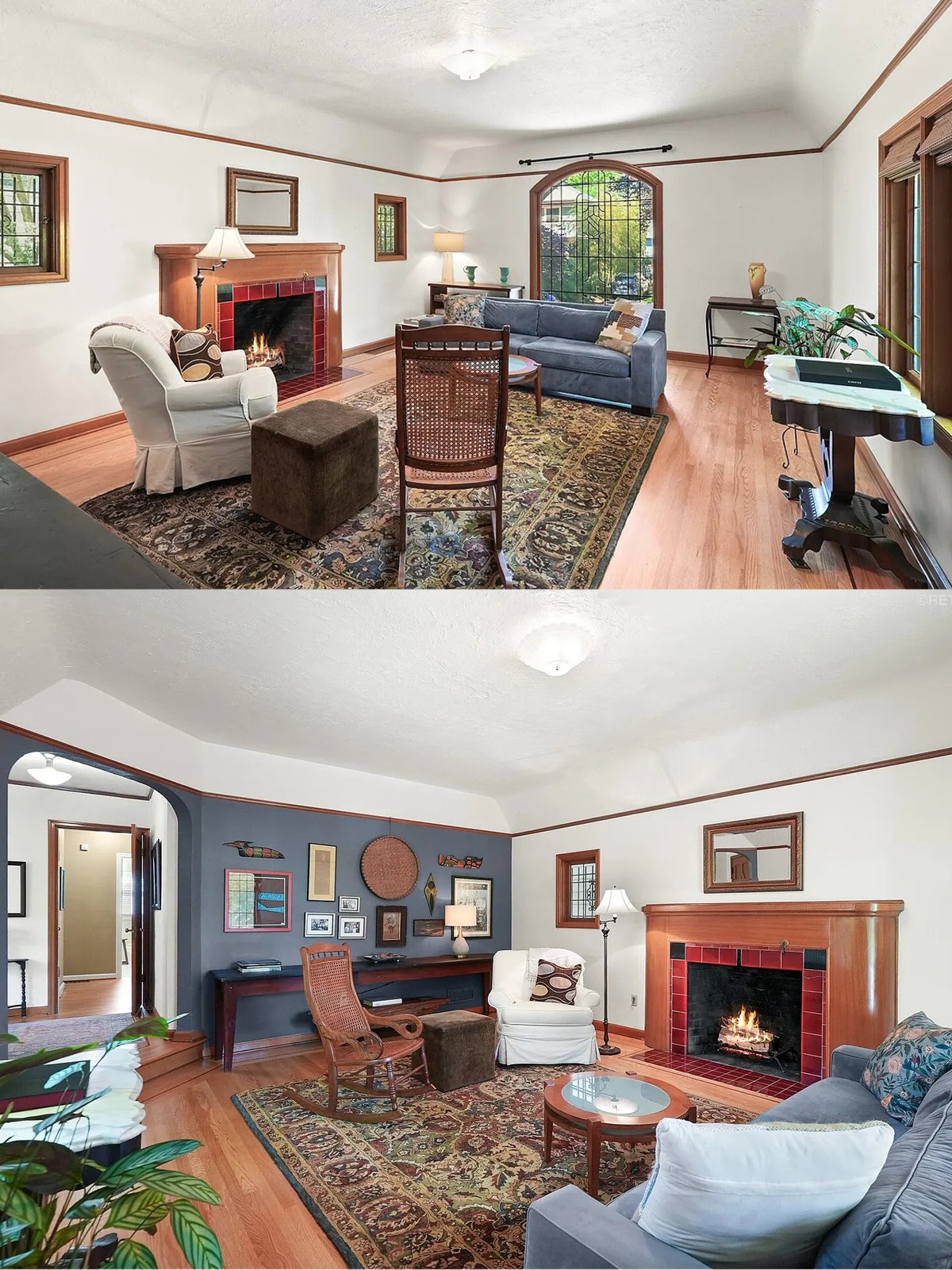
This room embraces deeper color.
A rich blue-gray accent wall gives the living room a cozy backdrop. Against it, framed art and a long wood desk create the feeling of a collected home.
The fireplace brings in the strongest historical detail. Its glossy wood surround frames dark red tile. That deep red feels warm and traditional. It also works beautifully with the brown and rust tones in the rug.
Instead of matching furniture, the room uses a mix. There is a soft gray sofa, a white slipcovered chair, and a woven wood rocker. That mix makes the space feel as though it grew over time.
This approach suits Tudor homes well. Perfect sets can feel too polished. A few different furniture styles often look more natural.
The result is cozy, personal, and full of character.
Design cues:
- Deep blue-gray feature wall
- Rich wood fireplace surround
- Dark red fireplace tile
- Arched doorway
- Original hardwood floors
- Traditional patterned rug
- Woven wood rocking chair
- Mixed furniture styles
- Framed collected artwork
- Warm wood trim
8. Vaulted Tudor Living Room With Dark Ceiling Beams
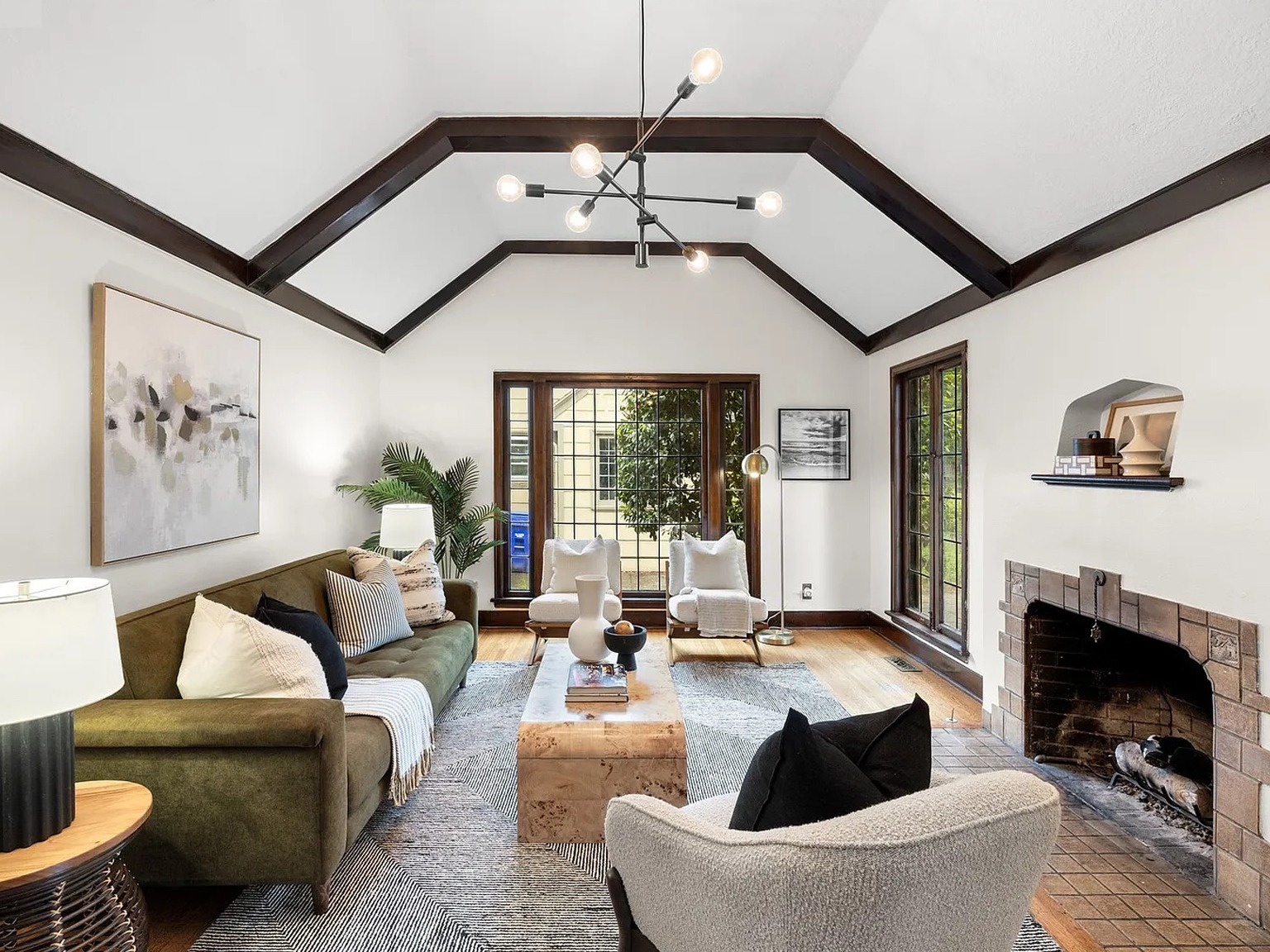
This room takes one of the strongest Tudor ideas and makes it feel modern.
Dark beams trace the shape of the vaulted ceiling. Their bold lines turn the ceiling into a major design feature. The contrast between dark wood and white plaster makes every angle easy to see.
Large divided-light windows repeat the same dark lines around the room. This creates a strong link between the ceiling and the walls.
The fireplace stays simple. Plain plaster surrounds a tiled opening. Rather than competing with the ceiling, it acts as a quiet secondary focal point.
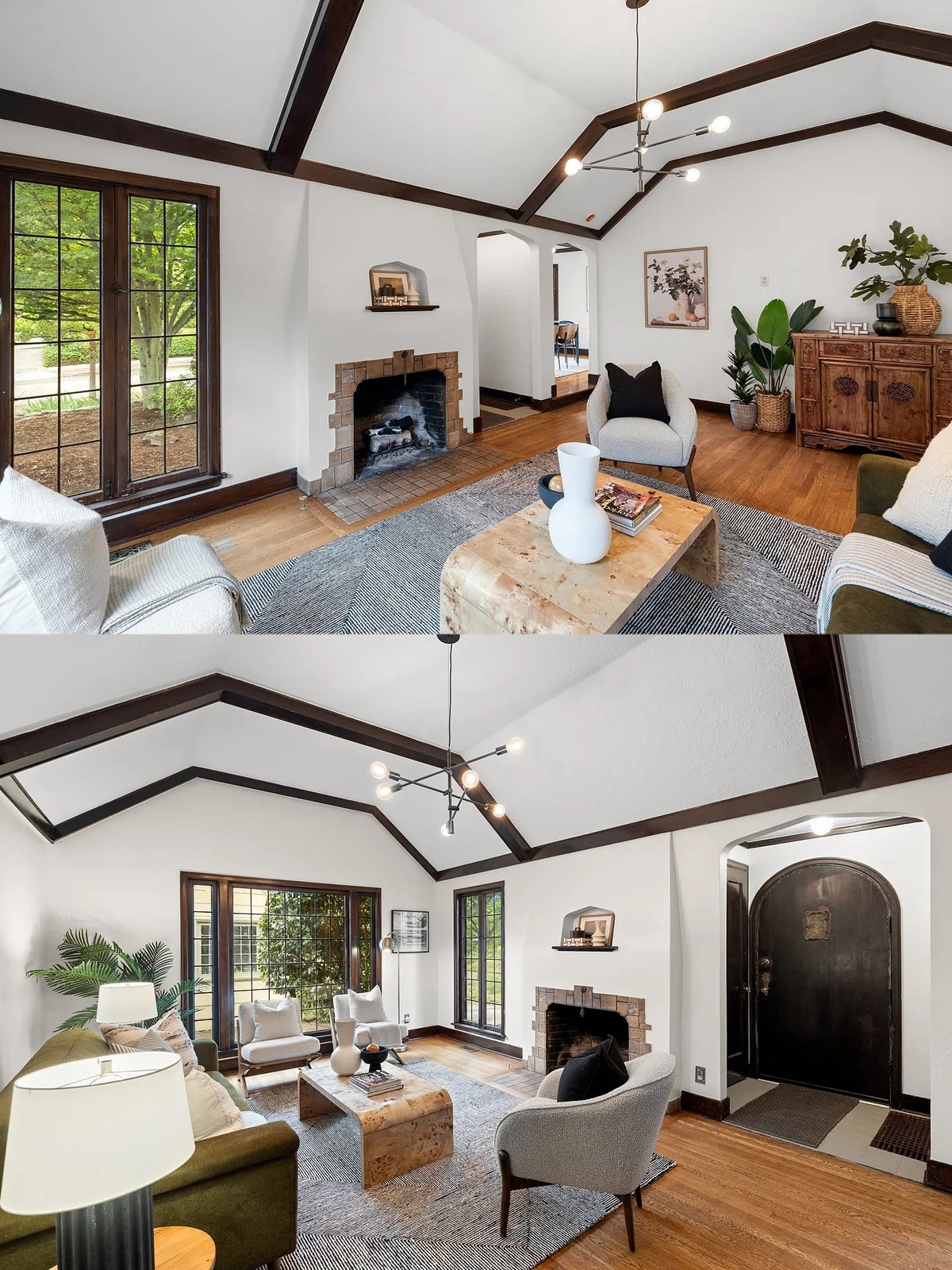
The furniture uses earthy colors. An olive sofa brings warmth. Cream chairs brighten the far end. Black pillows pick up the tone of the beams.
A black-and-white rug gives the floor a more current look.
This room feels unmistakably Tudor inspired, but it is not stuck in the past.
Design cues:
- Vaulted ceiling
- Dark exposed ceiling beams
- Divided-light windows
- Dark wood window trim
- Plaster fireplace
- Tile hearth
- Olive green sofa
- Cream lounge chairs
- Black-and-white rug
- Modern sculptural chandelier
9. Golden Tudor Living Room With Dark Beamwork
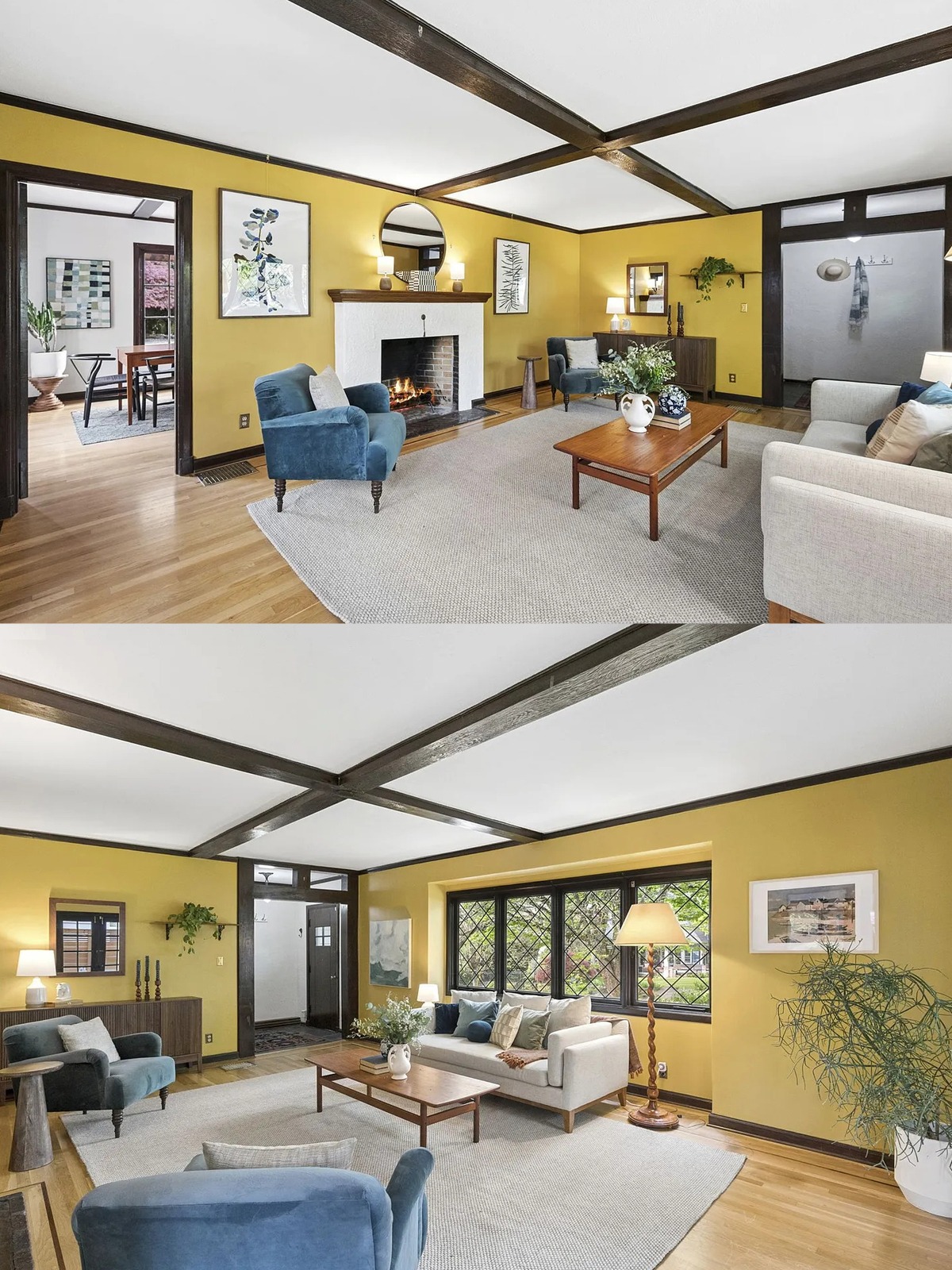
Color gives this room a very different personality.
Golden yellow walls create a warm backdrop. Dark wood beams, trim, and doorways frame the space. That strong contrast makes the room feel more dramatic.
The ceiling is one of its best details. Dark beams create large geometric sections across the white surface. This type of overhead framework suits Tudor-inspired interiors because it gives the ceiling visual weight.
A simple white fireplace breaks up the yellow walls. The dark brick inside the firebox adds depth.
Blue velvet chairs introduce a cooler color. Their rich tone works well with the gold walls. Meanwhile, cream seating keeps the palette from becoming too heavy.
The room has a bold look, yet the furnishings remain fairly simple. That lets the architecture stay in control.
Design cues:
- Dark ceiling beam grid
- Golden yellow walls
- Dark wood door casings
- White plaster fireplace
- Dark brick firebox
- Blue velvet chairs
- Warm wood coffee table
- Hardwood flooring
- Simple neutral rug
- Traditional wall sconces
10. Updated Tudor Living Room With Built-In Shelves
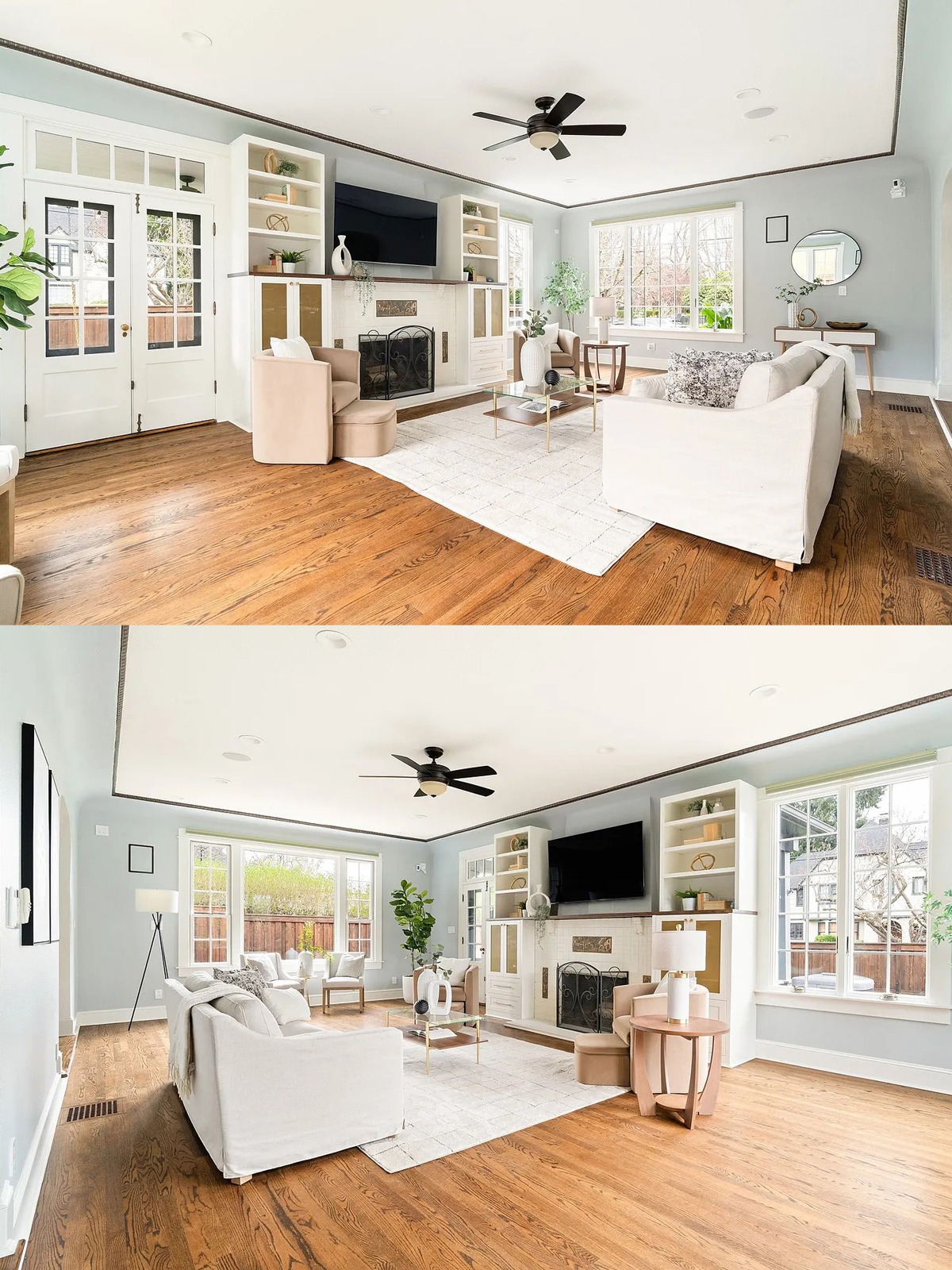
This room shows what happens when Tudor bones meet a light modern makeover.
The fireplace wall has built-in shelves on both sides. The symmetrical layout gives the room a more formal feel. Yet white paint keeps it fresh.
The dark television creates a bold center point above the fireplace. Warm beige cabinet doors below soften the black screen.
French doors add another older-home feature. Their grids of glass bring in pattern without adding more furniture.
The soft blue-gray walls feel calm and airy. Pale upholstery adds to that look.
One smart detail is the wood floor. Its rich tone keeps the room connected to the home’s age. Without it, the space might feel too new.
This room offers a useful lesson. When modernizing a Tudor living room, keep at least one strong natural material visible.
Design cues:
- Symmetrical fireplace wall
- Built-in bookshelves
- French doors
- Hardwood floors
- Pale blue-gray walls
- Light neutral upholstery
- Traditional fireplace opening
- Warm beige built-in accents
- Large divided-light window
- Simple ceiling trim
11. Soft Modern Tudor Living Room With Two Seating Zones
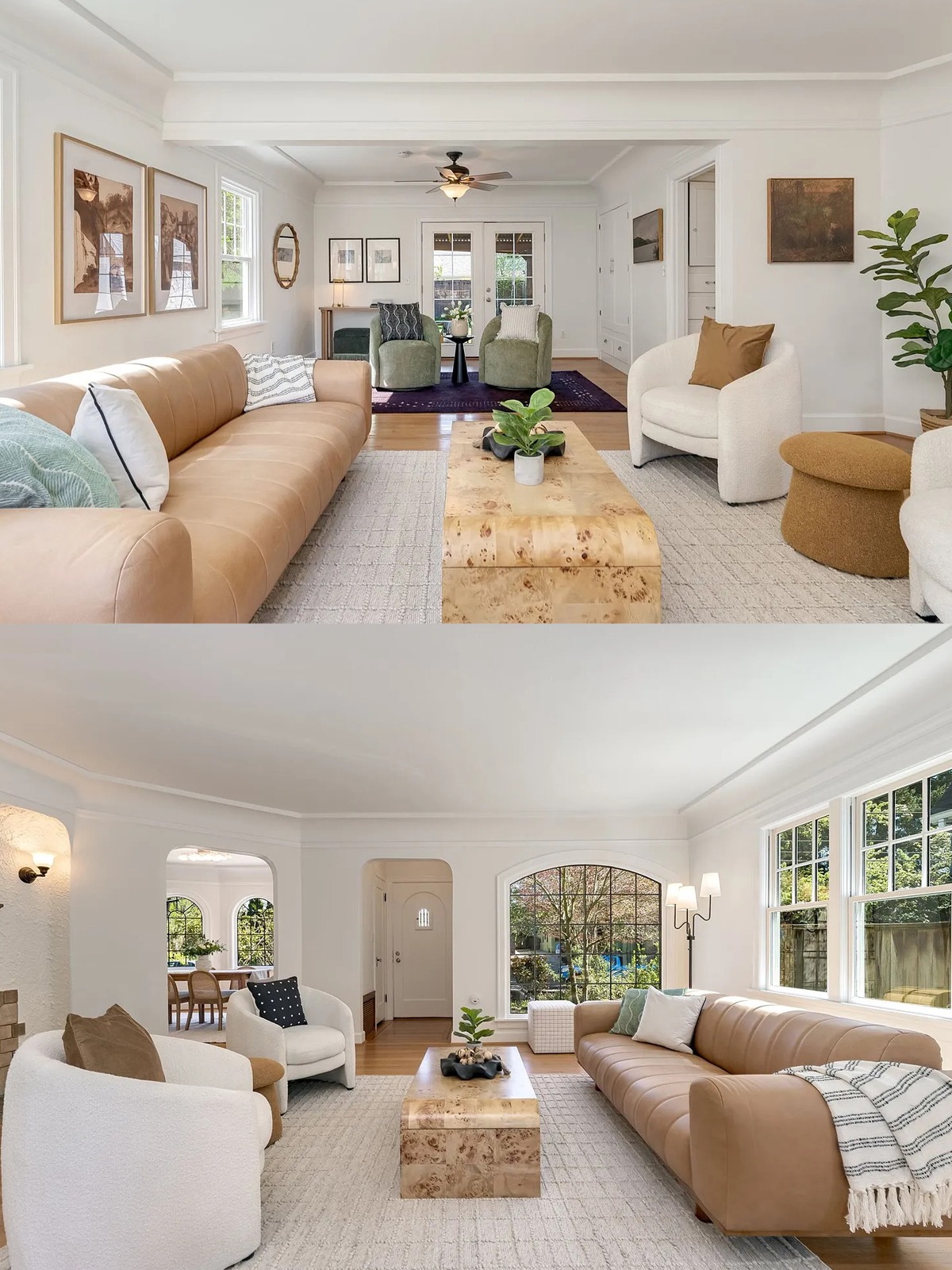
Not every Tudor living room needs to revolve around a fireplace. This space uses layout and architectural trim to create character.
The room is long, so the seating has been split into two areas. A tan leather sofa and curved white chairs define the main zone. At the far end, two green chairs create a smaller conversation spot.
That layered layout makes a large room feel more intimate.
The pale walls highlight the original trim. A wide beam-like opening separates the two parts of the room without closing them off.
The furniture adds soft curves. Those rounded forms balance the straight lines of the windows and trim.
A burl wood coffee table brings in natural texture. Its bold grain adds the warmth that Tudor rooms often need.
Design cues:
- Broad trimmed opening between rooms
- Original wood floors
- Pale walls
- Tan leather sofa
- Curved boucle chairs
- Burl wood coffee table
- Separate conversation zones
- Vintage-style area rugs
- Soft green accent chairs
- Simple framed artwork
12. Stone Fireplace Tudor Living Room
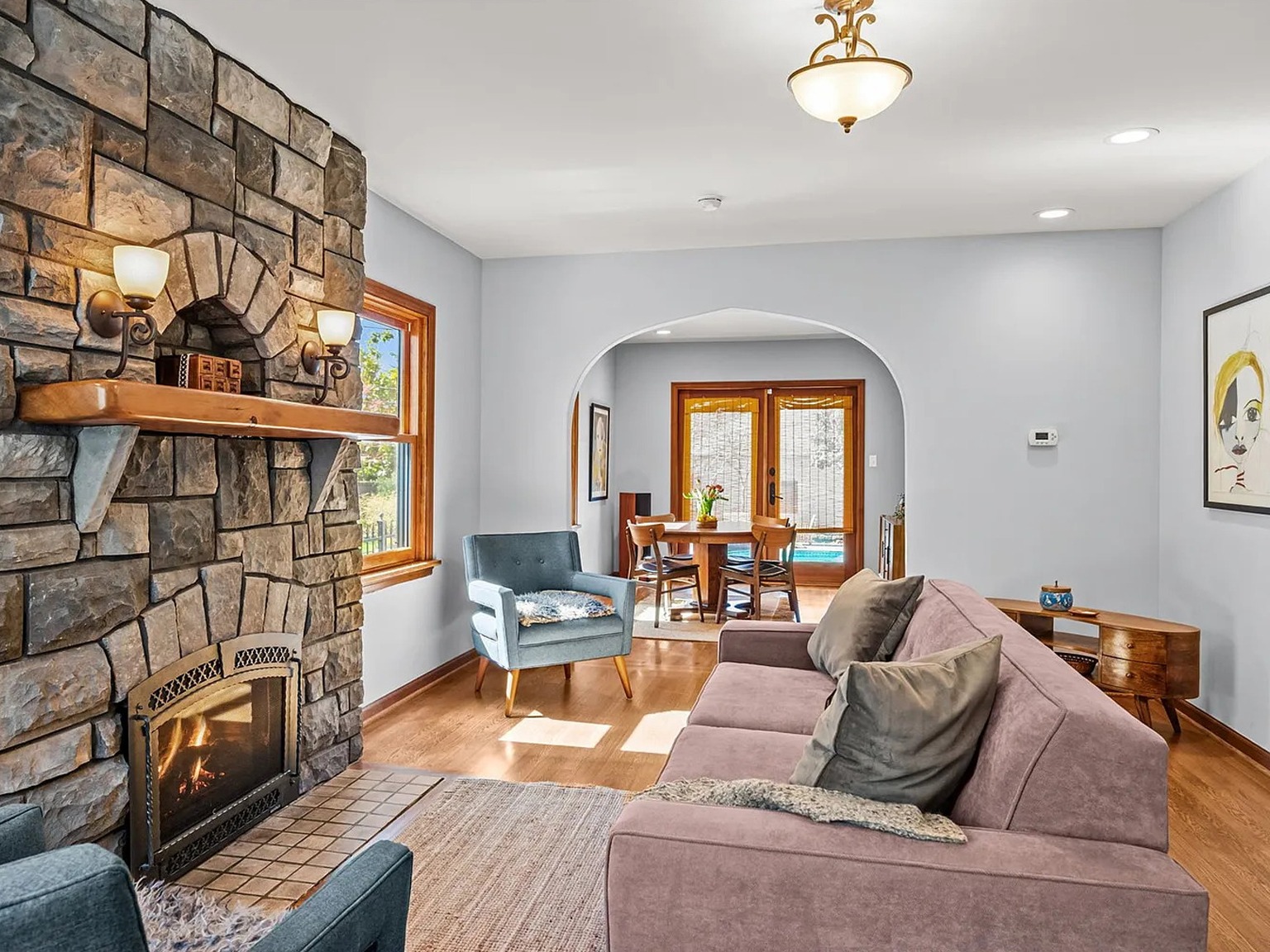
Here, the fireplace does almost all the talking.
Large blocks of rugged stone rise from floor to ceiling. Their rough texture gives the room a strong lodge-like feel. Yet the arched opening above the mantel keeps the feature connected to Tudor design.
The thick wood mantel softens the stone. It also ties the fireplace to the warm wood window trim and flooring.
The rest of the room stays simple. A muted rose sofa provides gentle color. Blue-gray chairs add contrast.
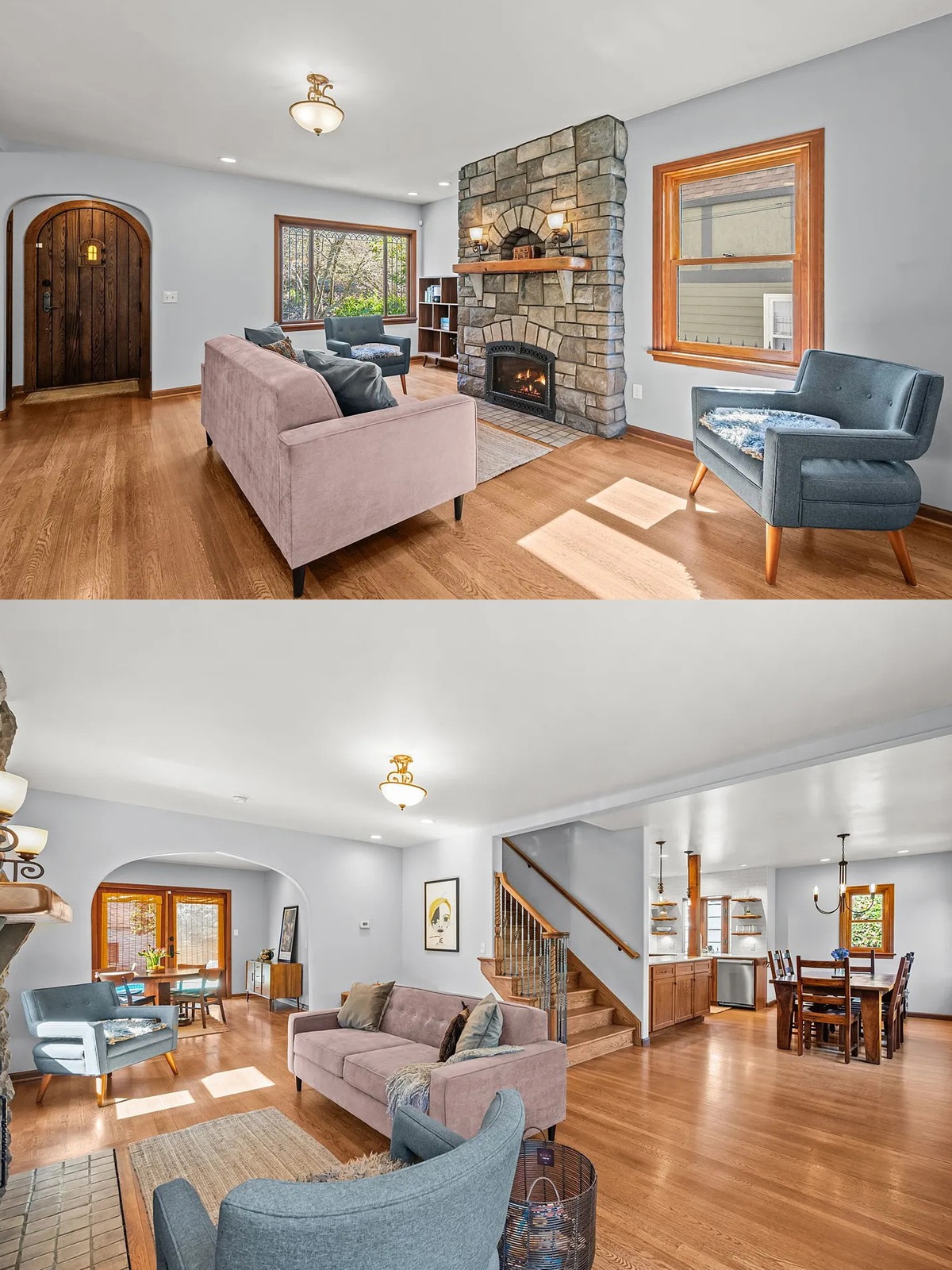
An arched doorway leads into the dining space. That curve repeats the shape above the mantel and creates a nice visual rhythm.
Because the stone carries so much visual weight, the walls remain pale and quiet.
This is a strong lesson for rooms with big architectural features. Let one feature lead. Everything else can support it.
Design cues:
- Massive stone fireplace
- Thick wood mantel
- Arched niche above the mantel
- Arched doorway
- Warm wood window trim
- Hardwood floors
- Muted rose sofa
- Blue-gray chairs
- Soft neutral rug
- Simple wall colors
13. Light Tudor Living Room With a Classic White Fireplace
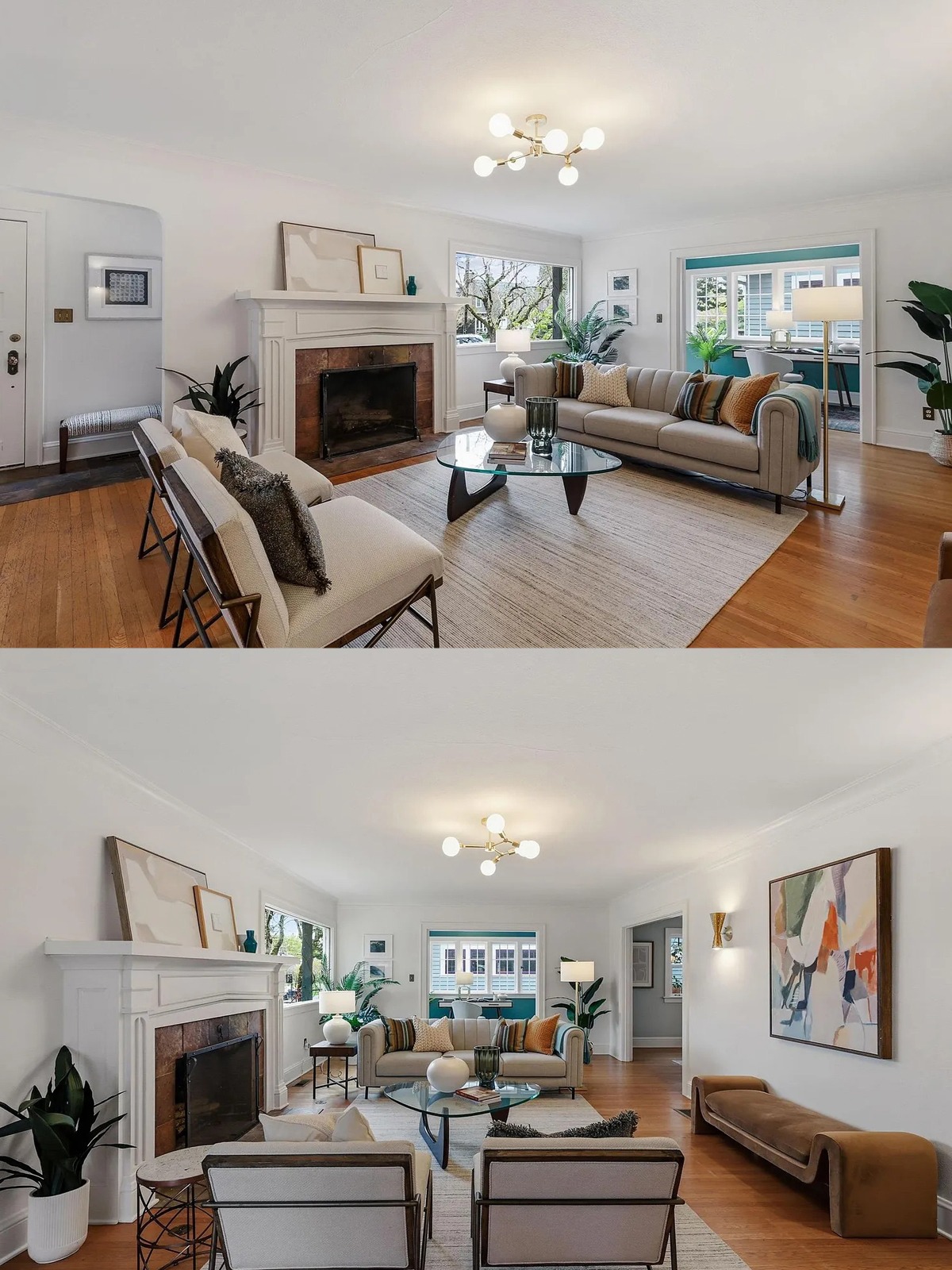
This room uses a lighter color palette while keeping its traditional roots.
The white fireplace has a wide mantel and layered molding. Terracotta-toned tile inside the opening adds warmth. The fireplace feels classic without looking heavy.
A large glass coffee table adds contrast. Its curved shape keeps the center of the room open.
The sofa has rolled arms and channel details. This gives it a subtle traditional feel. Yet the pale beige fabric keeps it current.
Two slender lounge chairs face the sofa. Their dark frames bring in just enough contrast.
One doorway opens toward a small room with a teal accent wall. That flash of color gives the otherwise neutral living room more personality.
Design cues:
- White traditional mantel
- Warm-toned fireplace tile
- Hardwood floors
- Rounded glass coffee table
- Neutral upholstered sofa
- Dark-frame lounge chairs
- Large picture windows
- White wall trim
- Houseplants
- Small pops of teal and rust
14. Charcoal Tudor Living Room With Floating Shelves
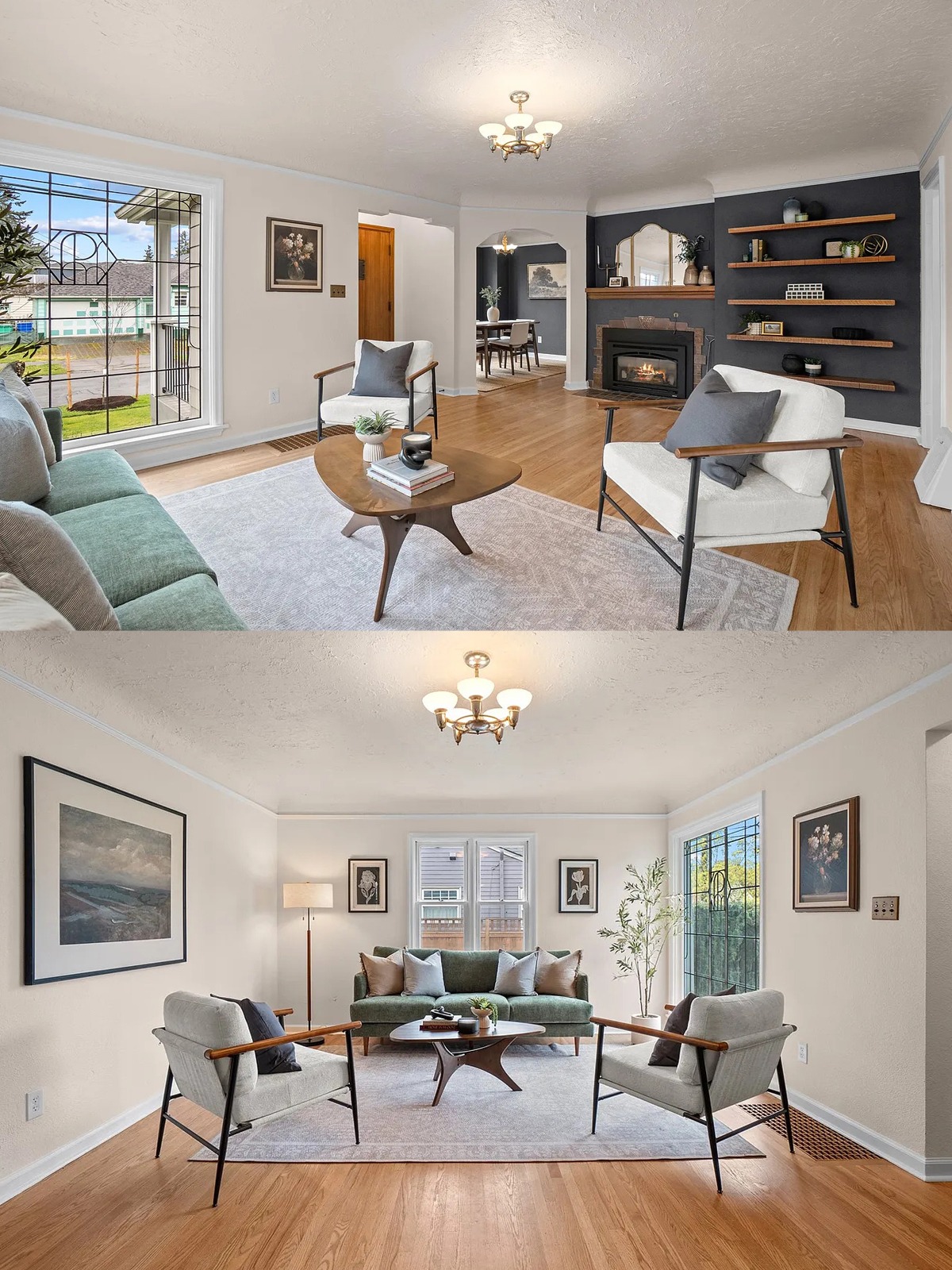
Dark paint gives this room a sharp, updated look.
The fireplace wall is painted charcoal gray. That one move turns a modest fireplace into the room’s main focal point.
Wood floating shelves stretch across one side. Their natural grain adds warmth and stops the dark wall from feeling flat.
The fireplace surround uses a similar warm wood tone. This creates a strong link between the old fireplace and the newer shelving.
A green sofa adds another earthy shade. Meanwhile, two white chairs keep the front half of the room bright.
The large leaded-style window is an important historic cue. Its decorative metal pattern brings detail without adding clutter.
This room shows how dark paint can work well in Tudor interiors. The trick is to balance it with white upholstery, light walls, and warm wood.
Design cues:
- Charcoal accent wall
- Floating wood shelves
- Warm wood mantel
- Leaded-style window
- Arched opening
- Green sofa
- White accent chairs
- Hardwood floors
- Mid-century wood table
- Neutral patterned rug
15. Calm Tudor Living Room in Warm Beige
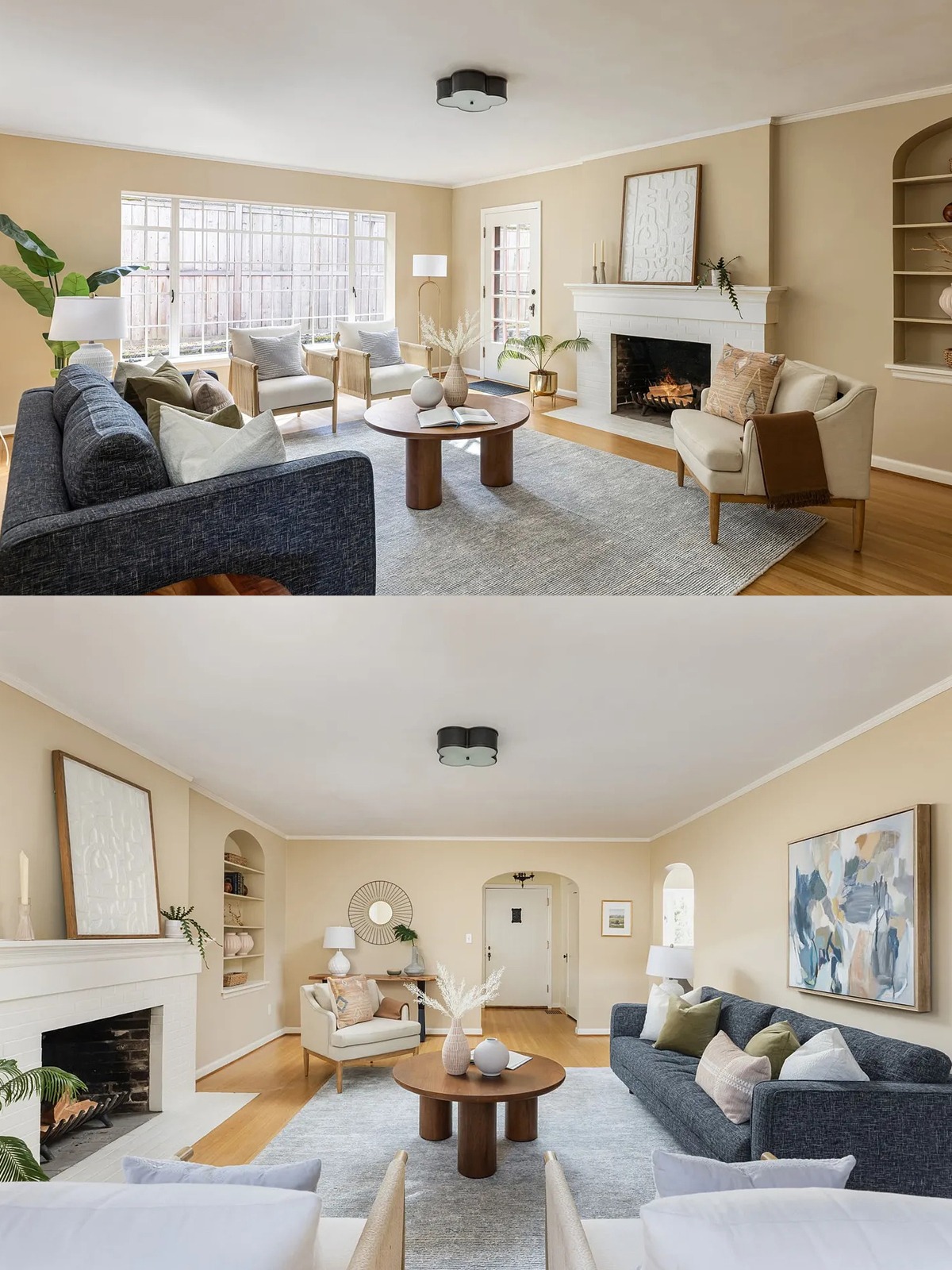
Warm beige covers the walls in this soft, relaxed Tudor living room.
Instead of strong contrast, the room uses gentle shades of cream, gray, wood, and tan. This makes the space feel calm.
The white fireplace blends into the room rather than standing apart from it. An oversized textured artwork rests above the mantel. That keeps the fireplace current without changing its classic shape.
A built-in arched bookcase adds an architectural cue on the right side. The arch matters. Curves are common in Tudor-inspired doorways, niches, and built-ins.
Large windows fill the opposite wall. Their white trim creates a lighter, more updated look.
Furniture stays simple. A dark navy sofa grounds the room. Light wood chairs and a cream armchair soften it.
Design cues:
- Warm beige walls
- White-painted fireplace
- Arched built-in bookcase
- Large multi-pane windows
- Hardwood floors
- Navy sofa
- Light wood lounge chairs
- Cream armchair
- Gray woven rug
- Natural plants and ceramics
16. Refined Tudor Living Room With Wood-Framed Bay Windows
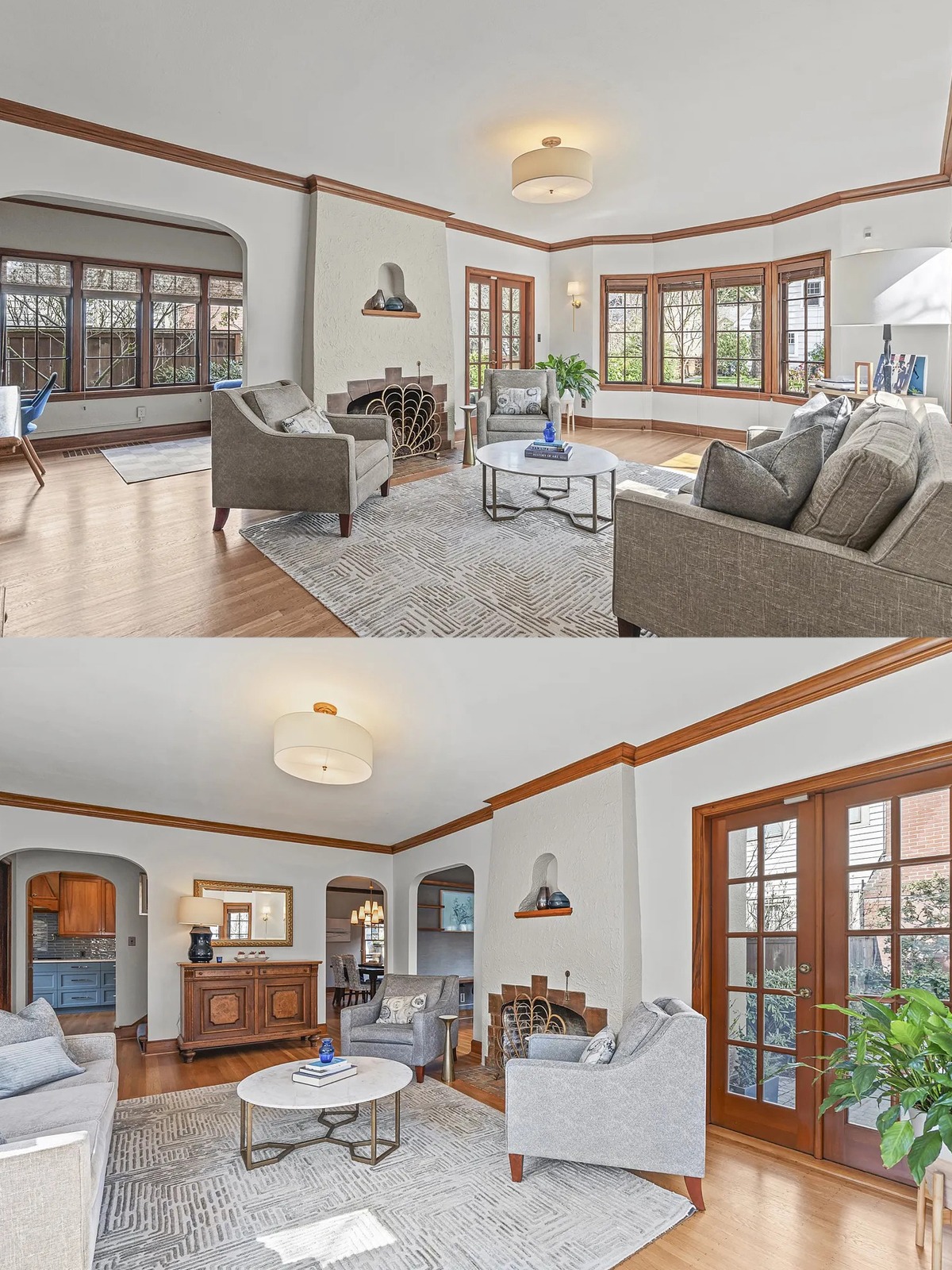
The windows define this room.
A wide bank of dark wood-framed windows wraps around the corner. Their small panes create a classic Tudor feel. They also bring a warm rhythm to the pale walls.
Wood crown trim follows the ceiling line. Rather than painting it white, the design keeps the wood visible. That choice helps preserve the home’s period character.
The fireplace has a simple plaster surround and a tiled opening. A small arched niche above it adds a charming detail. That niche makes the otherwise simple fireplace feel custom.
Gray furniture keeps the room quiet. A patterned gray rug adds depth without introducing a strong new color.
The result feels refined and understated. The room does not rely on decorative Tudor motifs. Instead, the character comes from the windows, wood, arches, and fireplace.
Design cues:
- Dark wood window frames
- Multi-pane bay windows
- Wood crown trim
- Plaster fireplace surround
- Decorative tile firebox
- Small arched mantel niche
- Arched room opening
- Hardwood flooring
- Gray upholstery
- Low-pattern neutral rug
17. Airy Tudor Living Room With a Black Brick Fireplace
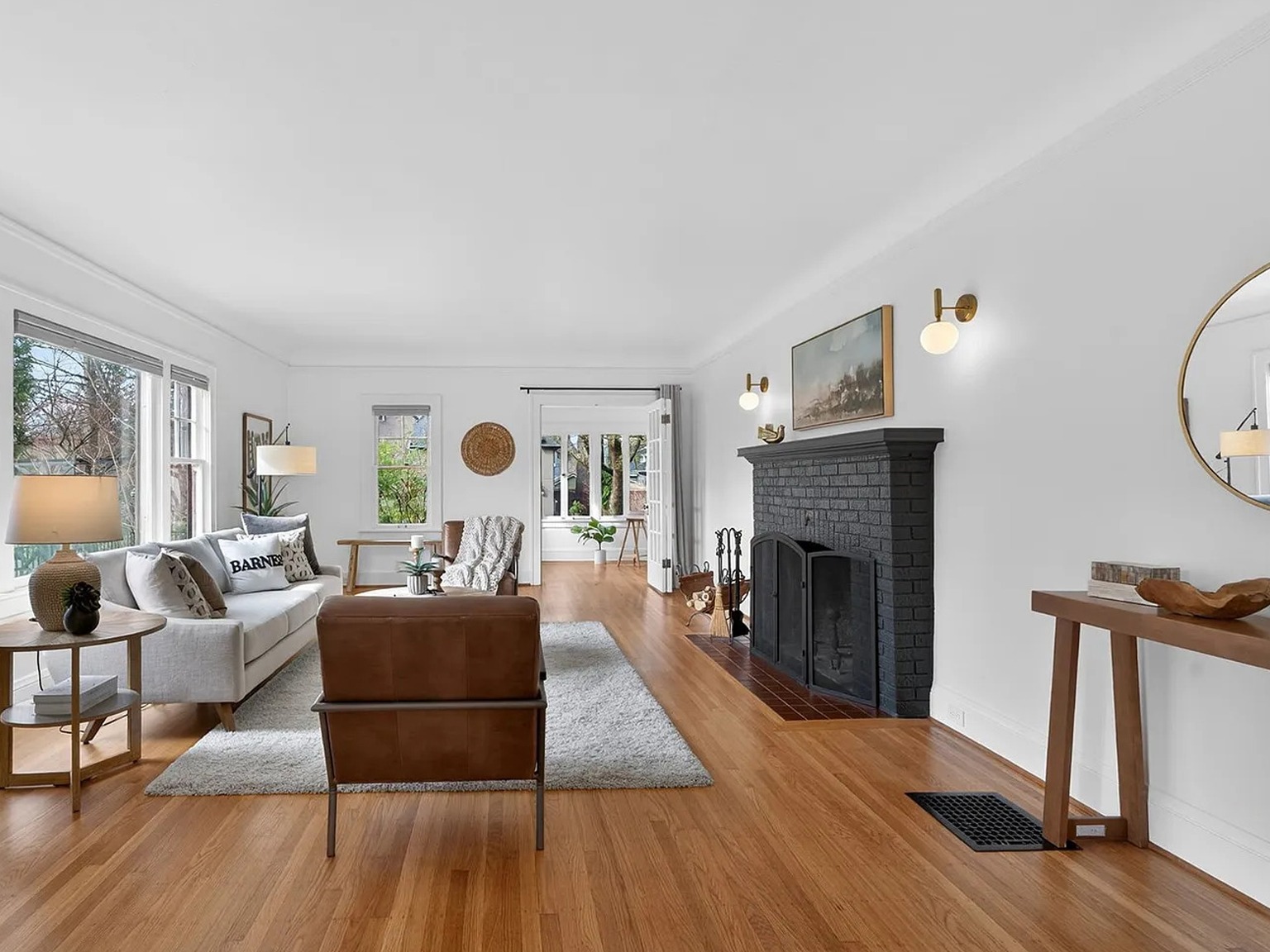
The last room has one of the cleanest looks in the group.
Most of the surfaces are white. This makes the space feel open and bright. Yet the fireplace provides a strong dark anchor.
Its brick face is painted black. A dark mantel caps the top. Two brass wall sconces sit above it and add warmth.
Original hardwood floors bring natural color across the room. A brown leather chair repeats that warmth near the center.
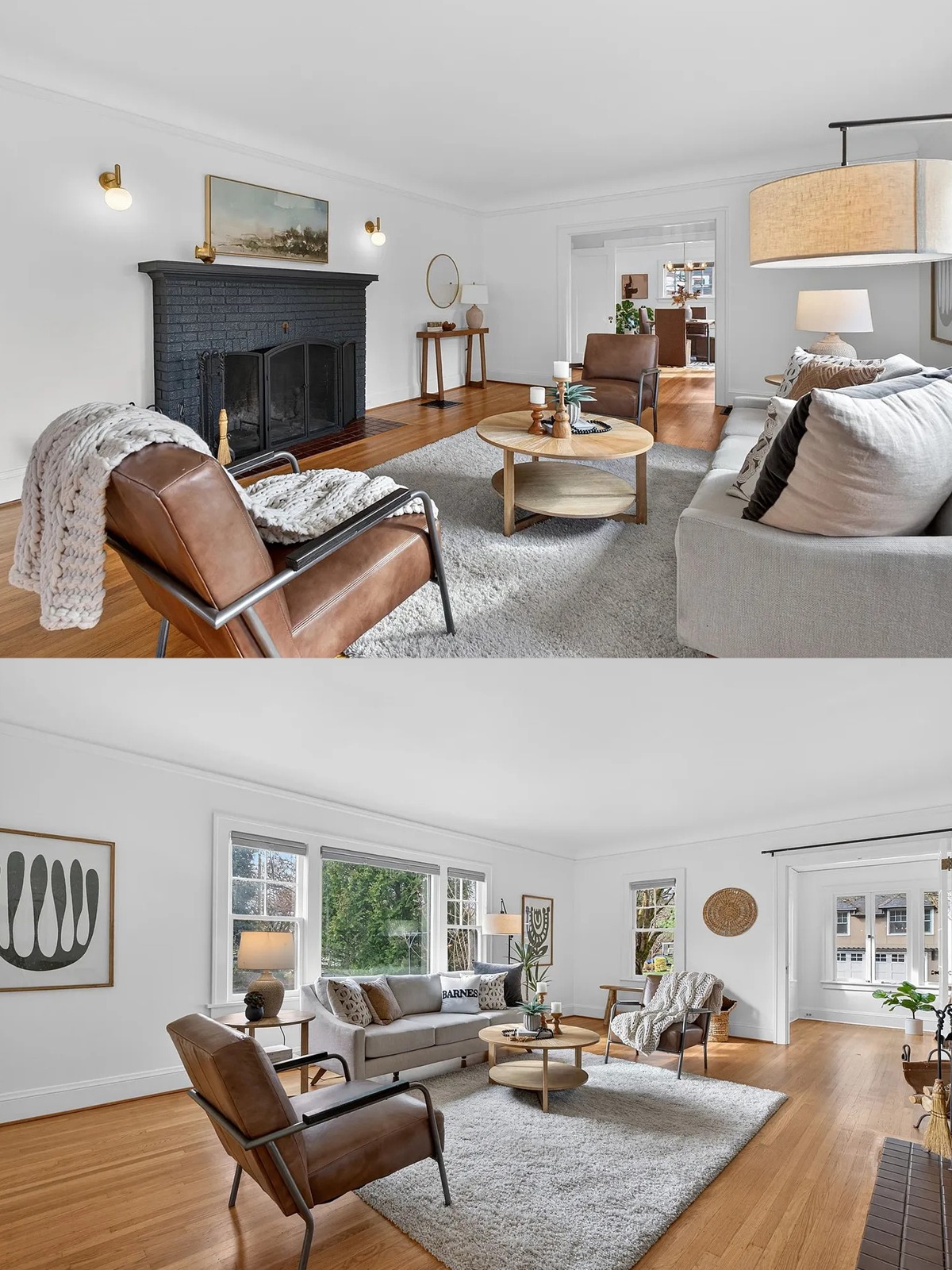
Large white-trimmed windows line the left wall. Their tall proportions still feel traditional even after the surrounding trim has been painted.
The room also uses several warm wood pieces. A slim console table, side tables, and woven lamp base keep the white walls from feeling cold.
This is a great approach for someone who loves Tudor architecture but prefers a lighter decorating style. Preserve the fireplace. Keep the wood floor. Add a few warm pieces. Then let white walls give the old room a fresh start.
Design cues:
- Black-painted brick fireplace
- Dark fireplace mantel
- Brass wall sconces
- Tall traditional windows
- White-painted trim
- Original hardwood floors
- Brown leather accent chair
- Warm wood side tables
- Soft white sofa
- Neutral rugs and textiles
Conclusion
A great Tudor living room starts with the architecture. Keep the fireplace, woodwork, arches, windows, or beams that give the room its story. Then add comfortable furniture, warm textures, and a color palette that suits your style. You can go light and airy or rich and moody. Either way, the best Tudor living rooms feel collected, cozy, and easy to live in.